
Is the ability to breastfeed impaired after breast augmentation?
Depending on the method used, the ability to breastfeed is retained in most cases.



Breast augmentation allows you to express your personality and self-confidence. Nevertheless, it needs to be carefully considered. Dr Niklas Noack, an experienced specialist in plastic and aesthetic surgery, offers personal consultation and state-of-the-art methods for breast augmentation with implants at his renowned practice in Berlin. You can rely on sound expertise, individually tailored treatment and a result that looks natural and harmonious.
Welcome to our information page on upper arm lift surgery in Berlin. Here you will find all the relevant information about upper arm lift surgery to help you make an informed decision. Our aim is to give you a detailed overview of the procedure, the different methods, costs and financing options as well as the procedure for an upper arm lift.
The most important facts in brief:
| Technical term | Breast augmentation |
|---|---|
| Goal | Volume augmentation, optimisation of breast shape and firmness |
| Method | Insertion of a silicone implant under the breast |
| Duration of the operation | approx. 1.5-2 hours |
| Anaesthesia | General anaesthesia |
| Hospitalisation | 1-2 days, also outpatient if necessary |
| After the operation | Removal of drainage tubes (if inserted) and dressing change after one day, showering possible after 3 days, light Restriction of movement in the arms |
| Pain | Moderate to moderate wound pain in the first few days; Feeling of tension for 4 - 6 weeks; |
| Follow-up treatment and behavioural recommendations | Regular wound checks (2 to 3 follow-up checks), Suture removal after 2 weeks, Special brace and bra for 4 to 6 weeks day and night, Sauna and gradual increase in sporting activities after 6-8 weeks, Solarium and/or sun exposure of the seam after 1 year or earlier, but then application of sun protection factor 50 |
| Scars | Generally not very visible after healing (depending on the method) |
| Social and labour skills | After 7 to 10 days |
| Durability | approx. 15-25 years |
| Risks | General operational risks; special risks: Tissue hardening (capsular fibrosis), Sensory disturbances, Asymmetries, Slipping of the implants, Restricted ability to breastfeed (in the case of an incision on the nipple), Breast Implant Illness (BII), BIA-ALCL |
| Side effects | Tension pain (depending on implant size), Swelling, bruising; Rarely: Foreign body sensation |
Breast augmentation, medically known as breast augmentation, is a cosmetic procedure to change the size, shape and volume of the breast. It aims to harmonise the proportions of the body, it can boost self-confidence and fulfil individual expectations in terms of breast aesthetics. This procedure is extremely versatile, as it can compensate for genetic imbalances as well as changes caused by pregnancy, breastfeeding or weight loss. The results are individualised and are always based on the patient's wishes and conditions.
Breast augmentation with implants is ideal for women who are unhappy with the natural volume of their breasts or want symmetrical adjustments. Common reasons for wanting a breast augmentation include genetically small breasts, changes after breastfeeding or loss of volume due to age and weight. The decision is always individual and should focus on personal well-being.
Breast augmentation with implants is one of the most effective methods for customising the volume, shape and symmetry of the breasts. There are different access routes for the procedure. The most common method is the incision in the breast fold (inframammary, underbust fold), which offers optimal access for modelling the breast and is barely visible later on. Another approach is via the areola (periareolar), which can be particularly advantageous for small breasts or specific anatomical conditions. Alternatively, implants can be inserted through the armpit (axillary), but this method is not recommended by Dr Noack.
Depending on the patient's anatomical requirements and wishes, either round or anatomically shaped (teardrop-shaped) implants are used. Round implants are particularly suitable if a visible push effect is desired, while anatomical implants can reproduce a natural breast shape. However, this cannot be generalised: a round implant does not always look unnatural, nor does a teardrop-shaped implant always look natural. The individual case decides. For additional comfort and a natural feel, the implants are usually made of cohesive silicone gel, which is particularly safe to use.
Implants, autologous fat or the Preservé™ method? Find out in just 60 seconds which type of breast augmentation is best suited to your body and your desired outcome.
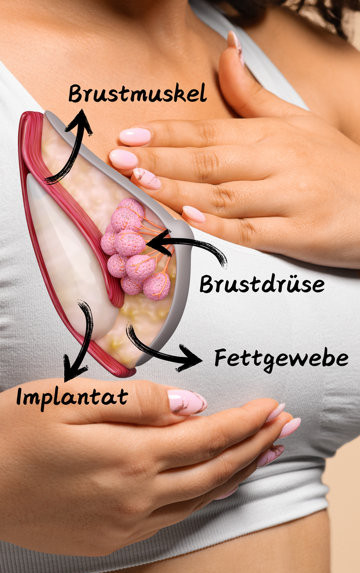
The implants can be placed either behind the pectoral muscle (subpectoral) or in front of the pectoral muscle (epipectoral).
Subpectoral placement is often the preferred option as it provides better coverage of the implant, especially with a small initial breast, and ensures a very natural appearance.
This method has also been proven to reduce the risk of capsular fibrosis. For selected cases, Dr Noack also offers the so-called complete submuscular breast augmentation, in which not only the large pectoral muscle but also other muscles are lifted. This serves in particular to stabilise the lower pole of the breast.
For certain patient anatomies or correspondingly desired results, placement in front of the muscle can also be useful in order to achieve a good breast contour.
The first step in breast augmentation with implants is a detailed consultation. During this consultation, all aspects of the procedure, the incision, the choice of implants and their positioning as well as possible risks are discussed. Before the procedure, it is strongly recommended that you stop taking certain medications and reduce the consumption of nicotine and alcohol in order to optimise the healing process.
Before the operation, the initial findings, i.e. the current condition of the breast, are photodocumented. During the operation, which is performed under general anaesthetic, the implant is inserted either through an incision in the breast crease or in the nipple area. The choice of access route depends on your individual needs, requirements and wishes. The procedure usually takes between one and two hours.
For breast augmentation with implants, Dr Noack focuses on "rapid recovery", i.e. recovering as quickly as possible after the operation. After the operation, we recommend staying in the clinic for one night to ensure complete aftercare. In some cases, outpatient treatment is also possible. In the operating theatre, you will be given a support bra and a stabilisation belt ("Stuttgart belt") for the correct implant position, which should be worn for around 4-6 weeks. The stitches are usually removed after ten to twelve days. During the first few weeks, you should take it easy physically, sleep mainly on your back or slightly sideways and avoid sport or heavy activities. Sauna and solarium visits as well as direct sun exposure are possible again after about two to three months. Regular follow-up checks help to secure the result in the long term and recognise possible complications at an early stage.
The costs vary depending on the chosen method, the type of implants and the individual scope of treatment. For greater planning certainty, Dr Noack will provide you with a precise cost breakdown during the consultation, depending on the findings.
AUSGEZEICHNET Basierend auf 56 Bewertungen
 Gepostet auf Google
 Aleksandra Jovanovic10. Februar, 2026Ich habe eine Brustvergrößerung bei Dr. Noack machen lassen . Es ist genauso geworden wie ich es wollte . Ich kann Dr. Noack nur empfehlen.Gepostet auf Google
 Tanja Kraemer3. Januar, 2026Meine Augenlidstraffung und Gliding Brow Lift liegt nun 3 Monate zurück. Das Ergebnis könnte nicht besser sein! Die OP unter Vollnarkose verlief ohne Komplikationen und die Heilung der Narben und Schwellungen gingen, so wie besprochen, nach ca. 3 bis 4 Wochen zurück und sind heute nicht mehr sichtbar. Ich bin von Dr. Niklas Noack absolut begeistert - menschlich sowie seine Expertise in der plastischen Chirurgie haben meine Erwartungen übertroffen. Das Beratungsgespräch, der OP Tag und die Nachsorge waren super angenehm und sehr professionell. Eine Empfehlung von Herzen! Thank you will never be enough💚Gepostet auf Google
 Michaela Krebs30. Dezember, 2025Ich war vor über 2 Jahren zunächst zur Beratung bei Herrn Dr.Noack. Er hat sich viel Zeit genommen und alles genau und verständlich erklärt. Dann habe ich mich dieses Jahr entschieden, mein Vorhaben in die Tat umsetzen zu lassen und ich bereue es keine Sekunde. Alles ist so geworden, wie ich es mir vorgestellt habe. Herr Dr.Noack ist sehr kompetent, einfühlsam und einfach auch sehr sympathisch. Auch die Nachbetreuung und die nette Dame am Empfang, waren perfekt. Danke für das schöne Ergebnis. Augenlidstraffung und Gliding Browlift.Gepostet auf Google
 Agathe Hütter13. Oktober, 2025Ich war mit einer meiner Klientinnen bei Dr. Niklas Noack in Berlin zum Beratungsgespräch zu einer möglichen Asymmetriekorrektur der Brust. Selten habe ich eine so klare, empathische und fachlich exzellente Beratung erlebt wie bei ihm (und ja, beruflich habe ich mit vielen Fachärzten für Plastische und Ästhetische Chirurgie zu tun) . Dr. Noack verbindet höchste medizinische Kompetenz in der plastischen Chirurgie mit einem feinen Gespür für natürliche Ergebnisse. Man merkt sofort, dass es bei ihm nicht ums Verkaufen geht, sondern um ehrliche Aufklärung und individuelle Lösungen. Als Aesthetic Consultant begleite ich Frauen bei der Wahl ihres passenden Facharztes für Plastische und Ästhetische Chirurgie und Dr. Noack gehört definitiv zu den Experten, die ich von Herzen weiterempfehle. Wer Wert auf Qualität, Natürlichkeit und Transparenz legt, ist bei Dr. Noack in den besten Händen. Vielen Dank, dass Sie sich so viel Zeit für uns genommen haben.Gepostet auf Google
 M. B.2. September, 2025Ich bin seit einem Jahr Patientin bei Herrn Dr. Noack und habe in dieser Zeit verschiedene Behandlungen durchführen lassen. Mit den Ergebnissen war ich immer sehr zufrieden und fühle mich bei ihm in guten Händen. Die Beratungen empfinde ich als besonders gewissenhaft. Herr Dr. Noack nimmt sich Zeit, erklärt mir die Abläufe verständlich, weist auch auf mögliche Risiken und Grenzen hin und lockt einen nicht mit überzogenen Versprechungen. Das gibt mir Sicherheit, weil ich dann weiß, was ich erwarten darf. Auch im persönlichen Umgang fühle ich mich wertgeschätzt. Ich werde ernst genommen und habe nie den Eindruck, zu viel zu sein. Besonders schätze ich, dass er nicht nur während der Behandlungen freundlich und aufmerksam ist, sondern auch danach genauso bleibt. Man wird nicht abgewimmelt, sondern weiterhin als Patientin gesehen und begleitet. Das ist mir persönlich sehr wichtig. Insgesamt fühle ich mich bei Herrn Dr. Noack fachlich wie menschlich bestens aufgehoben. Ich verlasse seine Praxis immer mit einem positiven Gefühl.Gepostet auf Google
 Miriam PPunkt24. August, 2025Dr. Noack ist ein fachlich kompetenter, freundlicher und empathischer Arzt. Er nimmt sich Zeit und erklärt Fragen detailliert und verständlich. Ich fühle mich jedes Mal nett empfangen - sowohl von der Assistentin vorne am Empfang, als auch von Herrn Dr. Noack. Merci 💚Gepostet auf Google
 J. “Carjea” Carlitscheck10. August, 2025Ich habe mich bei Dr.Noack] von Anfang an in den besten Händen gefühlt. Die Beratung war äußerst professionell, ehrlich und einfühlsam. Alle meine Fragen wurden ausführlich beantwortet, und ich hatte zu jedem Zeitpunkt das Gefühl, ernst genommen zu werden. Der Eingriff (Oberlidstraffung und Gliding-Brow-Lift) selbst verlief reibungslos und das Ergebnis hat meine Erwartungen sogar übertroffen – natürlich, ästhetisch und genau so, wie ich es mir gewünscht habe. Auch die Nachsorge war hervorragend organisiert. Das gesamte Praxisteam ist sehr freundlich, kompetent und sorgt für eine angenehme Atmosphäre. Ich bin sehr dankbar für das tolle Ergebnis und kann Dr.Noack und sein Team uneingeschränkt weiterempfehlen. (J. Carlitscheck)Gepostet auf Google
 Anke K.-L.22. Mai, 2025Bei mir wurde ein Facelift gemacht und ich sehe absolut natürlich aus. Das war mir sehr wichtig und Dr. Noack hat das perfekt umgesetzt. Alle Fragen wurden verständlich und ausführlich besprochen. Es herrschte stets eine ruhige und gelassene Atmosphäre, die meine Aufregung gut lindern konnte. Ich habe mich vor und besonders nach dem Eingriff medizinisch und menschlich gut betreut gefühlt. Und wie vorhergesagt, hatte ich wirklich keine Schmerzen! Das alles schafft Vertrauen, so dass ich bei Bedarf wiederkommen werde.Verifiziert von: TrustindexDas verifizierte Trustindex-Abzeichen ist das universelle Symbol des Vertrauens. Nur die besten Unternehmen können das verifizierte Abzeichen erhalten, die eine Bewertungsnote über 4.5 haben, basierend auf Kundenbewertungen der letzten 12 Monate. Mehr erfahren
Even with high quality and state-of-the-art methods, there are general risks that should be taken into account when undergoing breast augmentation with implants. These include swelling, slight scarring or temporary loss of sensation in the nipple area. Serious complications such as capsular fibrosis or implant displacement rarely occur, but may require repeat treatment in the long term. Breast Implant Illness (BII) and BIA-ALCL, a systemic lymphoma disease, are also extremely rare. Dr Noack explains these risks in detail.
As implants partially cover the breast tissue, this can make mammography more difficult. However, modern placement techniques and alternative examination methods such as ultrasound significantly reduce potential risks in the early detection of cancer. Scientific studies also show no connection between breast implants and an increased risk of breast cancer.
Immediately after the operation, you may experience a feeling of tension or slight muscle soreness in the breast area, but this normally subsides quickly. Occasional swelling or haematomas disappear completely after a few weeks. Regular use of scar care products supports healing and also reduces visible scars.
Even though breast augmentation is considered a safe procedure today, risks such as capsular fibrosis, altered scarring or sensitivity disorders can occur. However, thanks to modern procedures and Dr Noack's extensive experience, these risks are reduced to a minimum.
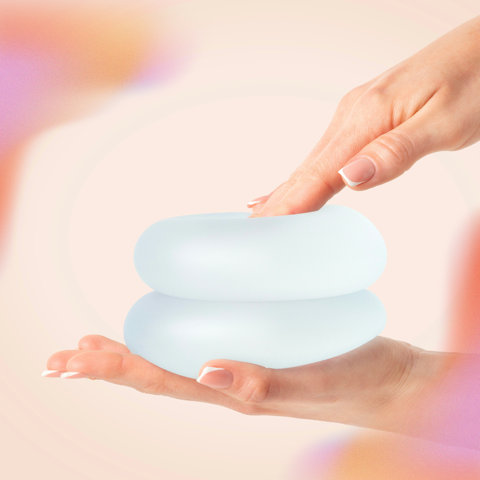
Most branded implants are considered safe today. It is important that implants authorised in Europe are used. These can be recognised by the CE marking combined with a four-digit numerical code. The most commonly used implants are filled with a cohesive, i.e. viscous, "cross-linked" silicone gel. All implants consist of a silicone shell, only the filling varies between silicone gel or saline solution.
The costs vary depending on the chosen method, the type of implants and the individual scope of treatment. For greater planning certainty, Dr Noack will provide you with a precise cost breakdown during the consultation, depending on the findings.
If you do not want to bear the costs all at once, our practice offers various financing options, e.g. through instalment payments, to make the procedure more accessible to you.
Depending on the method used, the ability to breastfeed is retained in most cases.
Most activities can be slowly resumed after two weeks, but intensive sport can only be resumed after six weeks.
The choice of implant is made individually during the consultation, taking into account your anatomical requirements.
After breast augmentation, muscle tension or hardened scars may occur in the breast area. This is often part of the natural healing process.
What you can do:
The choice of implant depends on your individual wishes and anatomical requirements.
Important factors:
There are two main types of implants:
Differences in form:
In the first few weeks after the operation, differences in the height or shape of the breasts are common.
Why is this happening?
When should you act?
Sport is temporarily restricted after breast augmentation.
Consult your doctor before resuming sporting activities, especially if they involve exercises with a high chest load.
After breast augmentation, you may experience feelings of tension or pain, especially if the implant is placed under the pectoral muscle.
Pain relief:
A special compression bra is recommended after the operation to support healing.
During pregnancy, hormonal changes can affect the shape of the breast, regardless of whether implants are present.
Possible effects:
Over the years, the skin and tissue can change while the implants retain their shape.
Possible changes:
Yes, breast augmentation can offer a very natural result with the right planning.
Important for natural results:
Saline implants are less popular because they:
Yes, breast augmentation and breast lift can be combined in one procedure.
Advantages of the combination:
Capsular fibrosis is a hardening of the tissue around the implant.
Causes:
Symptoms:
Treatment:
Implants can make mammography slightly more difficult, but modern examination methods compensate for this.
Dr Noack will give you comprehensive advice on how you can optimise your preventive care after breast augmentation.
Get personalised and comprehensive advice. Make an appointment with Dr Niklas Noack today and fulfil your wish for a breast augmentation that suits you. Place your trust in quality, expertise and empathetic care.
Click on the "Arrange a consultation appointment now" button to go directly to our online booking system.
Our practice is located in:
Alte Schönhauser Straße 23
10119 Berlin
Our opening hours are from Monday to Friday from 10:00 to 17:00.
I look forward to hearing from you.