
Can Preservé™ be combined with a breast lift?
Yes, absolutely. However, the Preservé™ technique alone is not sufficient for pronounced sagging that requires more extensive tightening. This is assessed individually based on the findings.



The Preservé™ breast augmentation is designed for women who are looking to enhance their figure in a targeted way, without having to accept the risks of general anaesthesia or long recovery times. Dr Niklas Noack uses this highly innovative, tissue-preserving method in Berlin to achieve a result that feels as natural as it looks – perfectly suited to an active lifestyle and the highest medical standards.
„Today, true surgical excellence is shown in respecting the tissue rather than traumatising it. With the Preservé™ method, we offer an aesthetic optimisation that does not appear operated on, but rather perfects the natural shape of the breast in a way that integrates harmoniously into the patient's life.“
The Preservé™ method is not a Breast augmentation in the classic sense. It is a surgical technique for patients who want targeted and precise optimisation - without dramatic changes, without a long stay in hospital, without a general anaesthetic. The result should look and feel as if it had always been there.
In Berlin, I offer the Preservé™ technique as a specialist in plastic and aesthetic surgery - for patients who know what they want and don't want to compromise on medical quality.
Preservé™ is a minimally invasive breast augmentation technique developed by Swedish plastic surgeon Dr Charles Randquist at the Victoria Clinic in Stockholm. It combines specially adapted instruments with advanced silicone implants from the Motiva® product line to place breast implants with a minimum of tissue trauma.
The special thing about Preservé™ is not just the result, but the way it is achieved: the surrounding tissue is not cut, but stretched. The pectoral muscle remains completely untouched. The nerve structures and natural supporting ligaments of the breast are preserved as far as possible. This results in shorter recovery times, less pain and a result that feels - literally - natural.
The method has proven itself in clinical practice in Scandinavia and Europe over several years and is performed by a small number of certified surgeons worldwide.
Are you looking for a targeted breast augmentation with the most natural result possible, minimal stress and faster recovery? The Preservé™ method offers an innovative, tissue-sparing alternative to traditional breast augmentation - developed for patients with the highest standards of precision, aesthetics and medical quality.
Implants, autologous fat or the Preservé™ method? Find out in just 60 seconds which type of breast augmentation is best suited to your body and your desired outcome.
The patient, who has a Preservé™ breast augmentation often differs fundamentally from the woman who is looking for a classic breast augmentation. It is often not a woman who is fundamentally dissatisfied with her breasts. It is someone who knows exactly what is missing: a little more fullness, a little more contour, more coherence between the upper body and overall proportions. A small but clear step towards the version of herself that she already has in mind.
Many of these patients have never seriously considered a traditional breast augmentation - because of the general anaesthetic, because of the downtime, because of the volume increments that the procedure typically entails. Preservé™ offers them an option that fits the reality of their lives: Minimal intervention, quick return to everyday life, natural result without anyone having to realise that something has been done.
This is not a compromise compared to classic breast augmentation. It is a different category - for a different starting position and a different objective.
Which initial situations can be treated with Preservé™?
With ther Preservé™ method the implant is placed subglandularly - i.e. above the pectoral muscle, directly behind the glandular tissue or in the layer below the muscle fascia. This has a decisive consequence: the pectoralis major muscle remains completely intact. There is no muscle pain, no restriction of arm mobility in the early healing phase and no so-called animation deformity - i.e. no visible implant deformation when tensing the chest muscles, as can occur with subpectoral placement.
At the same time, the subglandular position the natural movement behaviour of the Ergonomix² implantIt follows the force of gravity, changes its shape according to body posture and integrates harmoniously into the surrounding tissue.
The subglandular position requires sufficient soft tissue coverage. Tissue quality and skin thickness are therefore carefully assessed during preoperative planning - they are one of the basic conditions for ensuring that the result looks as it should.
The main technical difference to traditional breast augmentation is the way in which the implant pocket is prepared. Traditionally, the tissue is cut sharply with electrocautery or scissors - efficient, but associated with corresponding tissue trauma.
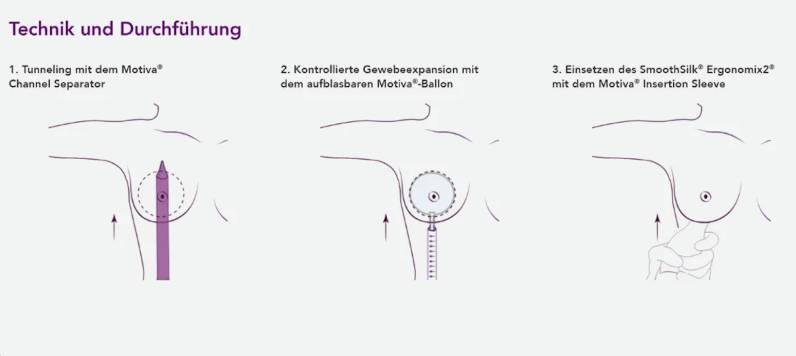
The Preservé™ technique does without it. Access is via a fine cut of about 2.5 centimetres in the underbust crease. From there, the Motiva® Channel Separator is used to create a tunnel through the tissue - not by incision, but by blunt separation. This means: Fabric fibres are pushed aside, not severed. Nerves, blood vessels and the Cooper ligaments - the natural supporting ligaments of the breast - are largely preserved.
This has direct clinical consequences: less bleeding, less swelling, less risk of infection, faster healing and a significantly lower risk of changes in nipple sensitivity.
Where classical techniques are prepared with instruments, Preservé™ relies on another special element: the Motiva® Inflatable Balloon. This inflatable disposable balloon is inserted into the tissue layer via the prepared tunnel and inflated in a controlled manner. The resulting volume gently displaces the tissue - until a pocket is created that is precisely matched to the selected implant.
The result is a precisely moulded, anatomically fitting cavity without having to sacrifice tissue. The pocket then fits snugly around the implant - which contributes to clinically proven positional stability: In a prospective study, a rate of 0 % inferior implant dislocation was recorded after three years.(Drop out - complication) documented.
One of the main differences between the Preservé™ method Compared to a classic breast augmentation, it is possible to perform the procedure without a general anaesthetic. In suitable cases, Preservé™ can be performed under local anaesthesia in combination with light intravenous sedation - the patient is relaxed and pain-free, but not completely anaesthetised.
This is no small detail. General anaesthesia is not a harmless routine element: it requires pre-operative preparation and fasting, increases the risk of complications in the case of certain pre-existing conditions, prolongs the recovery phase and ties up post-operative monitoring capacity. Those who can do without anaesthesia gain on several levels - both medically and practically.
The procedure takes about Usually 30 to 60 minutes. Most patients leave the practice on the same day.
Whether the procedure is possible for you under local anaesthesia depends on the individual findings and the selected implant volume. This will be discussed together during the consultation - without predetermining one way or the other.
Someone who has not had a muscle intervention recovers differently to someone who has had the large pectoral muscle (pectoralis major) mobilised. This circumstance follows anatomical logic.
After aPreservé™ breast augmentation most patients report significantly less pain than after a classic augmentation. Swelling and haematomas are usually manageable and disappear quickly. Many are after one to two days They can resume light professional activities - especially desk work or working from home - after a few days.
In the first few days after the procedure, physical rest is recommended. important, and the compression bra must be worn consistently, to stabilise the implant during the early healing phase. From the second to third week light sporting activity is usually possible again. Four to six weeks In most cases, more intensive sport can be resumed after the procedure - this is a clear difference compared to classic procedures with muscle interventions, where rest is often recommended for three months or longer.
The final result is not visible immediately after the procedure. The implant will sit slightly higher in the first few weeks than it will in the long term - this is normal and no cause for concern. The final contour will be visible after three to six months, when the tissue has fully adapted.
The main technical difference to traditional breast augmentation is the way in which the implant pocket is prepared. Traditionally, the tissue is cut sharply with electrocautery or scissors - efficient, but associated with corresponding tissue trauma.

The Preservé™ method is technically adapted to the implants of the Motiva® product line specifically the SmoothSilk Ergonomix² implant from Establishment Labs. The implant and instruments were developed to match each other: The Implant is compact and flexible enough to be inserted through the small Preservé™ access without sacrificing quality or dimensional stability.
The Ergonomix² is neither a classic round implant nor an anatomical implant in the traditional sense - it is an implant that reacts to its position. When standing, it takes on a slightly teardrop-shaped contour due to gravity. When lying down, the gel is distributed evenly and naturally. This behaviour is made possible by the ProgressiveGel Ultima® technology: a multi-layer silicone gel with variable cohesiveness that imitates the mobility of real breast tissue.
The SmoothSilk® surface is microstructured and biocompatible. In clinical studies, a low capsular contracture rate has been documented for Motiva® implants with this surface - less than one per cent in several published studies. Cases of BIA-ALCL have not yet been reported for this implant surface.
For safety and traceability, Zen® RFID technology is integrated into each implant, enabling contactless external identification - at any time, without additional intervention. The BluSeal+® system serves as a visual quality assurance during production and indicates the integrity of the outer shell.
In the context of the Preservé™ method, moderate volumes are typically selected - in line with the aim of this technique and the anatomy of the patients for whom it is intended.
The Preservé™ method is suitable for patients who have sufficient breast tissue of their own and are looking for a precise, natural-looking optimisation with moderate volume. Typically, these are women who are planning their first breast augmentation and are looking for a procedure that is particularly gentle on the tissue, who want a discreet increase of usually one to two cup sizes, who do not have any pronounced excess skin or relevant breast sagging, who lead an active lifestyle and attach importance to a quick return to sport and work, who want to avoid a general anaesthetic or should avoid it for medical reasons, and who are looking for a result that is not recognisable as a procedure - natural, harmonious and permanent.
Preservé™ is not a universally applicable technique. The method reaches its limits when a large implantation volume is desired - with volumes well over 350ml, tissue trauma increases despite the gentle technique and the natural result becomes more difficult to achieve. It is also not a suitable option for pronounced ptosis (sagging of the breast), which requires a more extensive breast lift. Patients with very little autologous tissue and thin skin coverage must also be carefully considered: The subglandular position requires sufficient soft tissue coverage so that the implant is not palpable or visible.
If another method makes more medical sense, this will be clearly stated in the consultation. The discussion about this is not a sales pitch.
The operational process follows a defined protocol consisting of four steps.
In the first stepprecise body measurements are taken: Breast base width, skin quality, soft tissue thickness, projection. This data determines the choice of implant and forms the basis for the entire surgical planning. The procedure is anatomically tailored to the individual patient - not the other way round.
In the second step After anaesthetising the area, an approx. 2.5 cm incision is made in the crease under the breast. The Motiva® Channel Separator is inserted and creates an access tunnel by bluntly separating the tissue without cutting fibres, nerves or ligaments.
In the third stepthe inflatable balloon expander is inserted into the prepared layer and inflated in a controlled manner. The tissue is gently and evenly displaced until a precisely fitting pocket is created for the selected implant.
In the fourth step the implant is inserted via a sterile no-touch insertion - using an insertion sleeve that prevents direct skin contact and further minimises the risk of infection. The access is then carefully closed.
The consultation before the procedure includes a detailed explanation of the method, choice of implant, form of anaesthesia and realistic course of the procedure. Aftercare includes close follow-up appointments in the first few weeks as well as individualised recommendations on weight-bearing and sporting activity.
No surgical procedure is without risks - this also applies to the Preservé™ method, whose tissue-sparing approach reduces certain risks, but does not completely eliminate them.
Common, generally temporary symptoms in the early healing phase are swelling, a feeling of tightness and occasional haematomas. At around 2.5 cm, the scar in the underbust crease is significantly smaller than with traditional approaches, but also undergoes the normal scar healing process over several months.
Rarer complications include infection, implant dislocation or - in very rare cases - capsular contracture. The clinical data for Motiva® SmoothSilk implants shows a low capsular contracture rate compared to classic smooth or textured surfaces. Cases of BIA-ALCL have not yet been described for this implant surface.
Changes in nipple sensitivity are rarer than with classic techniques due to the preservation of the nerve structures - however, they cannot be completely ruled out to a certain extent and should be realistically categorised.
An individual assessment of the risk situation - based on your anatomy, your medical history and the chosen procedure - is part of the consultation.
AUSGEZEICHNET Basierend auf 56 Bewertungen
 Gepostet auf Google
 Aleksandra Jovanovic10. Februar, 2026Ich habe eine Brustvergrößerung bei Dr. Noack machen lassen . Es ist genauso geworden wie ich es wollte . Ich kann Dr. Noack nur empfehlen.Gepostet auf Google
 Tanja Kraemer3. Januar, 2026Meine Augenlidstraffung und Gliding Brow Lift liegt nun 3 Monate zurück. Das Ergebnis könnte nicht besser sein! Die OP unter Vollnarkose verlief ohne Komplikationen und die Heilung der Narben und Schwellungen gingen, so wie besprochen, nach ca. 3 bis 4 Wochen zurück und sind heute nicht mehr sichtbar. Ich bin von Dr. Niklas Noack absolut begeistert - menschlich sowie seine Expertise in der plastischen Chirurgie haben meine Erwartungen übertroffen. Das Beratungsgespräch, der OP Tag und die Nachsorge waren super angenehm und sehr professionell. Eine Empfehlung von Herzen! Thank you will never be enough💚Gepostet auf Google
 Michaela Krebs30. Dezember, 2025Ich war vor über 2 Jahren zunächst zur Beratung bei Herrn Dr.Noack. Er hat sich viel Zeit genommen und alles genau und verständlich erklärt. Dann habe ich mich dieses Jahr entschieden, mein Vorhaben in die Tat umsetzen zu lassen und ich bereue es keine Sekunde. Alles ist so geworden, wie ich es mir vorgestellt habe. Herr Dr.Noack ist sehr kompetent, einfühlsam und einfach auch sehr sympathisch. Auch die Nachbetreuung und die nette Dame am Empfang, waren perfekt. Danke für das schöne Ergebnis. Augenlidstraffung und Gliding Browlift.Gepostet auf Google
 Agathe Hütter13. Oktober, 2025Ich war mit einer meiner Klientinnen bei Dr. Niklas Noack in Berlin zum Beratungsgespräch zu einer möglichen Asymmetriekorrektur der Brust. Selten habe ich eine so klare, empathische und fachlich exzellente Beratung erlebt wie bei ihm (und ja, beruflich habe ich mit vielen Fachärzten für Plastische und Ästhetische Chirurgie zu tun) . Dr. Noack verbindet höchste medizinische Kompetenz in der plastischen Chirurgie mit einem feinen Gespür für natürliche Ergebnisse. Man merkt sofort, dass es bei ihm nicht ums Verkaufen geht, sondern um ehrliche Aufklärung und individuelle Lösungen. Als Aesthetic Consultant begleite ich Frauen bei der Wahl ihres passenden Facharztes für Plastische und Ästhetische Chirurgie und Dr. Noack gehört definitiv zu den Experten, die ich von Herzen weiterempfehle. Wer Wert auf Qualität, Natürlichkeit und Transparenz legt, ist bei Dr. Noack in den besten Händen. Vielen Dank, dass Sie sich so viel Zeit für uns genommen haben.Gepostet auf Google
 M. B.2. September, 2025Ich bin seit einem Jahr Patientin bei Herrn Dr. Noack und habe in dieser Zeit verschiedene Behandlungen durchführen lassen. Mit den Ergebnissen war ich immer sehr zufrieden und fühle mich bei ihm in guten Händen. Die Beratungen empfinde ich als besonders gewissenhaft. Herr Dr. Noack nimmt sich Zeit, erklärt mir die Abläufe verständlich, weist auch auf mögliche Risiken und Grenzen hin und lockt einen nicht mit überzogenen Versprechungen. Das gibt mir Sicherheit, weil ich dann weiß, was ich erwarten darf. Auch im persönlichen Umgang fühle ich mich wertgeschätzt. Ich werde ernst genommen und habe nie den Eindruck, zu viel zu sein. Besonders schätze ich, dass er nicht nur während der Behandlungen freundlich und aufmerksam ist, sondern auch danach genauso bleibt. Man wird nicht abgewimmelt, sondern weiterhin als Patientin gesehen und begleitet. Das ist mir persönlich sehr wichtig. Insgesamt fühle ich mich bei Herrn Dr. Noack fachlich wie menschlich bestens aufgehoben. Ich verlasse seine Praxis immer mit einem positiven Gefühl.Gepostet auf Google
 Miriam PPunkt24. August, 2025Dr. Noack ist ein fachlich kompetenter, freundlicher und empathischer Arzt. Er nimmt sich Zeit und erklärt Fragen detailliert und verständlich. Ich fühle mich jedes Mal nett empfangen - sowohl von der Assistentin vorne am Empfang, als auch von Herrn Dr. Noack. Merci 💚Gepostet auf Google
 J. “Carjea” Carlitscheck10. August, 2025Ich habe mich bei Dr.Noack] von Anfang an in den besten Händen gefühlt. Die Beratung war äußerst professionell, ehrlich und einfühlsam. Alle meine Fragen wurden ausführlich beantwortet, und ich hatte zu jedem Zeitpunkt das Gefühl, ernst genommen zu werden. Der Eingriff (Oberlidstraffung und Gliding-Brow-Lift) selbst verlief reibungslos und das Ergebnis hat meine Erwartungen sogar übertroffen – natürlich, ästhetisch und genau so, wie ich es mir gewünscht habe. Auch die Nachsorge war hervorragend organisiert. Das gesamte Praxisteam ist sehr freundlich, kompetent und sorgt für eine angenehme Atmosphäre. Ich bin sehr dankbar für das tolle Ergebnis und kann Dr.Noack und sein Team uneingeschränkt weiterempfehlen. (J. Carlitscheck)Gepostet auf Google
 Anke K.-L.22. Mai, 2025Bei mir wurde ein Facelift gemacht und ich sehe absolut natürlich aus. Das war mir sehr wichtig und Dr. Noack hat das perfekt umgesetzt. Alle Fragen wurden verständlich und ausführlich besprochen. Es herrschte stets eine ruhige und gelassene Atmosphäre, die meine Aufregung gut lindern konnte. Ich habe mich vor und besonders nach dem Eingriff medizinisch und menschlich gut betreut gefühlt. Und wie vorhergesagt, hatte ich wirklich keine Schmerzen! Das alles schafft Vertrauen, so dass ich bei Bedarf wiederkommen werde.Verifiziert von: TrustindexDas verifizierte Trustindex-Abzeichen ist das universelle Symbol des Vertrauens. Nur die besten Unternehmen können das verifizierte Abzeichen erhalten, die eine Bewertungsnote über 4.5 haben, basierend auf Kundenbewertungen der letzten 12 Monate. Mehr erfahren
Yes, absolutely. However, the Preservé™ technique alone is not sufficient for pronounced sagging that requires more extensive tightening. This is assessed individually based on the findings.
Breast implants are not lifelong medical devices. Regular check-ups - usually by ultrasound - are recommended. It is not possible to predict when or whether an implant change will be necessary.
The technique is designed to protect glandular tissue and nerve structures. Whether breastfeeding is possible after the procedure also depends on individual circumstances and cannot be guaranteed.
As a rule, Preservé™ is primarily designed for initial augmentation. For revision operations, the suitability depends heavily on the individual initial findings and is assessed on a case-by-case basis.
The method unfolds its potential in the moderate volume range. Sizes up to approx. 350-400 ml can be easily realised in suitable cases. For significantly larger volumes, the technique reaches its anatomical and surgical limits. The average implant sizes used in Preservé™ patients are 200-300 ml.
If you want to check whether Preservé™ is the right procedure for you, a personal examination is the only sensible next step. Photos provide an initial orientation - a valid assessment of whether your anatomy is suitable for this method and what result could realistically be achieved is only possible in a direct examination.
Counselling takes place in the practice AESTHETICS BERLIN instead,
Address:
Alte Schönhauser Straße 23,
10119 Berlin.
Appointments can be made via Doctolib be agreed.
Our opening hours
are from Monday to Friday from 10:00 to 17:00.
I look forward to hearing from you.